In addition to being an effective horror story with a post-apocalyptic feel, The New World has an undercurrent of social and historical commentary, particularly as it relates to colonialism and the work done by religious missionaries. Did you set out wanting to write on that subject through the speculative fiction lens, or did those undertones creep into the story later?
The idea I started with was ‘bugs from another world.’ It takes me a ridiculously long time to write a short story, and during that time I read God’s Jury, Cullen Murphy’s beautiful and terrifying history of the Inquisition. It got me thinking about the religious component of the clash of cultures. The moral certainty that drove the ferocity of the subjugation of the Americas came out of the Church. Or at least it gave a moral framework to support that desire for conquest. Like it says in Romans, “If God be for us, who can be against us?”
What is your writing process like typically? Or do you have a different process for every story?
My process is all over the place. I write most productively when something comes out of the ether and hits my brain the right way. So, when I’m not working my day job I’m trying to expose myself to as much of the things that might do that; good books, poetry, art, strange music and good conversation. Having writer pals who understand helps!
What is your favorite piece of insect-related fiction?
Oh, there’s so much great stuff to choose from it’s hard to pick one thing. I remember reading “Leiningen Versus the Ants” in junior high school and being captivated by the fact that there really were such things as army ants, and my favorite story by Stephen King is “The Mist,” with its giant, mutated dragonflies and spiders. And I could go on about bug movies for days.
As we mature, our relationship with the creepy-crawly elements of the world changes, as does our emotional (and sometimes physical) response. Can you tell us one early or notable experience you’ve had with bugs that helped shape how you view them?
When I was a kid my friends and I spent all our time wandering the woods and fields around our neighborhood in suburban Maryland. I remember once coming on a spider suspended between two trees. It was probably a black and yellow garden spider – they typically get to be a couple of inches across, but I remember it as being this huge, bulbous thing as big as my hand. After that, my imagination had them lurking everywhere. I don’t think I’ve ever really gotten used to big bugs.
What are you working on now/what do you have upcoming that you want people to know about?
My next novel from St. Martin’s is coming in April. It’s called The Poor Boy’s Game, and it’s a crime novel, though it’s really about family, as are all my novels. The plot centers on a woman, an ex-federal marshal, who has to protect someone from her own father, a vicious thug and career criminal.
One of the perennial points of contention in the world revolves around education -- who should get educated (and to what degree), what should be taught, who should be excluded. Meanwhile, children in their classrooms ask, “Why do I need to know this?” Tell us one obscure thing you learned in school that you think is important, and why.
Oh, all the best, most interesting stuff is obscure to somebody. I was fascinated by the labor movement when I was young and remember reading about things like the Boston Police Strike and the Battle of Blair Mountain. Learning that companies would drop bombs on American workers to avoid paying living wages to folk who mined coal was pretty central to my understanding of the way things work.
We all have our favorite authors, some of whom everyone has heard of, and some of whom are relatively obscure. Who is one of the more obscure writers you love? What do you love about their work? Tell us which story or novel of theirs we should drop everything to read right now.
I don’t know if he would be considered obscure, but I love, love Tom Drury’s work. He wrote one of my favorite novels, The End of Vandalism, centering on a group of wonderful and seemingly very ordinary characters in a small midwestern town and his latest, Pacific, picks up the same characters years later. He’s one of those amazing writers who turn the smallest exchange into something both entertaining and revelatory about human frailty.
Unlikely Story #7 received a positive review from SFRevu in their January Issue. Congratulations to all our authors!
However unlikely it might seem, we’re running a bit behind with slush responses, particularly for the Unlikely Acceptances Issue. Between work, holidays, sickness, travel, and all the other pesky details of day to day life, we need a smidgen more time to get caught up. If you haven’t heard from us within our usual four-weeks, don’t panic. We’ll do our best to get back on track over the next week or two and send out responses as soon as we can. Thank you for your patience and best wishes for the start of the new year. May it be an unlikely one in all the best possible ways!
The theme of one insect using another as a host for its eggs, or an insect masquerading as human impregnating another human is one that turns up frequently in fiction, but in Pompilid you avoid the common tropes of body horror, holding the impregnation back as the surprise twist, or using the story as a thinly-veiled commentary on gender roles and relationships. Was this something you consciously set out to do? If not, what did you have in the back of your mind as you wrote this story?
When I first started as a writer, I was in love with splatterpunk, and there’s a part of me that still delights in being the gross kid who likes to throw worms at people. This story comes from that, and from a picture that I found when I was about 7. It was in a book about animals, and it featured a wasp entombing a tarantula in the way that’s described in the story. That picture and the description of the process fascinated me, and to me, the story never needed to be anything beyond a conversation conducted over a process that was both brutal and perfect. It never needed to be about humans or about how we see ourselves reflected in this intimate and ultimately fatal relationship. While they’re necessarily anthropomorphic, I wanted to keep the wasps and the tarantula a lot colder and more matter-of-fact than people are. I wanted to the tarantula to be resentful, but not furious or terribly fearful, and I wanted the wasps to see this as a perfectly natural, beautiful thing. I wanted us to see the process as they did.
What is your writing process like typically? Or do you have a different process for every story?
My writing process is a lot like trying to push a stuck cart down a hill. At first, it takes a lot of time, effort and research, and everything feels hard as I try to get the cart moving. After a while, the cart picks up its own momentum, and then I can just worry about making sure it doesn’t crash horribly. During times like this, I can knock out 5000 words without a problem, though whether they are good words or not is something that I only find out later on, in edits. Sometimes, the story never picks up momentum, and it’s a slog from beginning to end. The weird part is that I can’t tell the difference between stories that come easily and ones that are like pulling teeth after I have finished them.
What is your favorite piece of insect-related fiction?
This is probably a gimme for the audience of Unlikely Entomology, but E. Lily Yu’s “The Cartographer Wasps and the Anarchist Bees.” This is an amazing story, and if you’re reading this magazine and you haven’t read this story yet, go find it and read it right away!
What are you working on now/what do you have upcoming that you want people to know about?
Mostly I have short stories coming out in anthologies. My short story, “A Memory of White Flowers” is being published in the anthology, The Future Embodied, and it features memory implants and family history. “Neither Witch Nor Fairy,” a story about gender identity, family, the last witch burned in Ireland, and playing games with fairies, is being published in Long Hidden.
We all have our favorite authors, some of whom everyone has heard of, and some of whom are relatively obscure. Who is one of the more obscure writers you love? What do you love about their work? Tell us which story or novel of theirs we should drop everything to read right now.
Oh man, this could be quite a list. I don’t know if Angela Carter is obscure, and it feels a little presumptious to say Italo Calvino, hmm. How about Rikki Ducornet?
The Wall Garden plays with disturbing imagery, shifts in time, and loops in on itself more than once. Did all that make it harder or easier to write? The image of the creatures trapped in the wall garden is particularly striking. Did the story have its genesis there, or did the idea of the wall garden evolve with the writing?
The story’s central idea, which was indeed that of something living inside a wall, derives from a series of nightmares I had back in 2003. At the time I lived with my family in the outskirts of Madrid, Spain, in a largish house with a generous basement. In the dreams I became convinced that someone was living inside the basement walls, an extremely gaunt sort of quasi-person that could go years without eating, and moved extremely slowly, sometimes taking months to traverse a few inches. The element that was most unsettling about the dreams wasn’t the creature itself, though, but the anguish of feeling that if such a creature existed, there was no way I’d be able to convince anyone else of its reality, short of knocking down the walls. “There’s something alive inside the walls” became an eerie, and eerily undermining, proposition. In order to demonstrate that it was untrue, one would have to tear apart one’s home.
As I was casting about for scary ideas back in the summer of 2013, I remembered those dreams. I wanted to convey to the reader the sense of dread and inescapability of the something-inside-the-walls proposition, and I thought that one way of accomplishing that might be by forcing the reader inside those very walls. I read some go-to passages by Kafka, as well as Octave Mirbeau’s The Torture Garden (1899), for inspiration. The latter’s exploration of decadence got me thinking about the moral dimensions of my story. I then backed into the notion of a person who commits a wicked deed, and whose conscience (itself possessing consciousness) is shoved inside the walls in the form a bug-like creature, while the rest of that person, unfettered by conscience, roams free. How could that person ever be made whole again, his or her two parts re-united? Pondering the possible answers to that question generated the story’s plot. I then wrote several versions of the story that used various flash-back and loop structures as a means of drawing the reader in and creating claustrophobia. After several attempts I hit on one that I felt worked, and to which early readers responded favorably (with eloquently apposite comments about the sickness of my mind). I’m glad you found the imagery disturbing.
What is your writing process like typically? Or do you have a different process for every story?
I tend to start with a striking image, which I try to turn into an ending, and then work my way backwards to the story’s opening. Sometimes the image turns out to be the opening, which screws things up. I like to have a plot outline, a setting and some character backgrounds before I sit down to write the story. Often I have a title before I begin.
What is your favorite piece of insect-related fiction?
As a child I was terrified by the giant spiders of Them! (1954). As a pre-teen and early teen I read a lot of Spider-Man comics. Then there were the arachnoid “Bugs” of Heinlein’s Starship Troopers (1959). As a late teen, I remember that I was quite struck by Floria Sigismondi’s insect-themed video to Marilyn Manson’s “Tourniquet” (1997). Not sure how it holds up. I was also intrigued by the relationship that Edgler Vess, the killer of Dean Koontz’s Intensity (1995), had with spiders. Kafka’s The Metamorphosis (1915), of course. And the X-Files episode “War of the Coprophages” (1996), as much for Darin Morgan’s writing as for the critter effects, is one of my favorites.
As we mature, our relationship with the creepy-crawly elements of the world changes, as does our emotional (and sometimes physical) response. Can you tell us one early or notable experience you’ve had with bugs that helped shape how you view them?
Playing in a sandbox in a Southern California school when I was seven years old and being repeatedly stung by red ants didn’t encourage my love for them. And I’d already seen Them!.
What have you read recently/what are you reading currently/what is on your TBR pile that you’re excited about?
Recent reads are D. T. Max’s bio of David Foster Wallace, Every Love Story Is a Ghost Story (2012), and Joe Queenan’s One for the Books (2012). Currently reading Javier Marias’ The Infatuations (2011) and Isaac Asimov’s The World of Carbon (1958). Exciting TBR items: all of them, of course! (That’s why they graduate to the TBR pile). A few titles: The Simpsons and Their Mathematical Secrets (2013) by Simon Singh, Proxima (2013) by Stephen Baxter, Shaman (2013) by Kim Stanley Robinson and Evil Eye: Four Novellas of Love Gone Wrong (2013) by Joyce Carol Oates.
What are you working on now/what do you have upcoming that you want people to know about?
I recently finished my first solo novel, tentatively titled Reyla’s Song, and I will be working on edits and submissions to agents in early 2014. My short story “Hot and Cold” will be appearing in Analog sometime in 2014. I’d like to alert UK readers to the British publication of When the Blue Shift Comes, a two-novella collaboration with Robert Silverberg, in March 2014.
We all start somewhere, and the learning curve from first publication is a steep one. What’s your first ever published work, and how do you feel about it now?
My first story (sold for token payment) was “The Filigree” in 2008. I like the idea but today I’d execute it differently.
Since we’re coming up on the holiday season, and there’s no escaping it -- what is your favorite holiday-related entertainment (movie, TV special, song/album, book or story)? What is your least favorite?
I’m looking forward to reading the Gardner Dozois and Sheila Williams-edited anthology Isaac Asimov’s Christmas (1997). Every year I say, “This is the year.” This is the year.
One of the perennial points of contention in the world revolves around education -- who should get educated (and to what degree), what should be taught, who should be excluded. Meanwhile, children in their classrooms ask, “Why do I need to know this?” Tell us one obscure thing you learned in school that you think is important, and why.
I believe that the act of remembering something can make it important, even if it isn’t objectively so. I sympathize with Fred Madison in David Lynch’s Lost Highway (1997), who says “I like to remember things my own way.” I’ve forgotten most of what I learned in school, so I’m not sure I can form a defense on those grounds.
We all have our favorite authors, some of whom everyone has heard of, and some of whom are relatively obscure. Who is one of the more obscure writers you love? What do you love about their work? Tell us which story or novel of theirs we should drop everything to read right now.
I’m not sure I love any truly obscure writers. If I know them, how obscure can they be? Well, except possibly for the nine “Soviet Latvian” poets gathered in the 1973 anthology Let Us Get Acquainted: Aleksandrs Caks, Janis Grots, Arvids Grigulis, Bruno Saulitis, Ojars Vacietis, Imants Ziedonis, Imants Auzins, Viktors Livzemnieks, and Maris Caklais. I think they’re pretty obscure. But I’m not convinced I love them. I mean, that’s a strong word. You might enjoy their poems. The short story collection The Book of Sei (1987) by David Brooks is perhaps not well-known, and I recommend it.
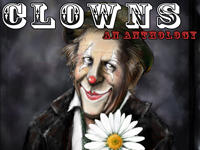
Clowns: The Unlikely Coulrophobia Remix is hot off the presses! So get your hot, pressed clowns today! Or if you prefer your clowns cold-pressed, never fear. A clown is nothing if not adaptable.
22 tales to horrify and delight, by authors Derek Manuel, T. Jane Berry, J.H. Pell, Jeff Wolf, Kristen Roupenian, Carolyn M. Yoachim, Mari Ness, Evan Dicken, Carlie St. George, Line Henriksen, Virginia M. Mohlere, Dayle A. Dermatis, Jason Arias, Joe Nazarre, Karlo Yeager-Rodruigez, Sara K. McNeilly, Chris Kuriata, Cassandra Khaw, Cate Gardner, Charles Payseur, Chillbear Latrigue, and Holly Schofield, with an introduction by Robin Blyn and illustrations by Bryan Prindiville.
 Unlikely Story