Two bits of news: First of all, the PDF of Issue 8, The Journal of Unlikely Cryptography, is now completed. It contains all the stories and artwork of the web version, as well as some bonus materials, like author interviews, bringing it to 120 pages. It’s also formatted such that if printed in spreads, there’s a little extra space on the interior margin for the benefit of handcrafters who want to play with bookbinding.
Secondly, we’re changing our distribution model. Rather than putting it up online for people to download for free, we’re offering free email subscriptions. Why are we doing this? To help build up a consistent readership, rather than relying on people to remember to come visit us every few months.
What does a subscription entail? Pretty simple: we will send you an email telling you that an issue is available online when it publishes on the web. The PDF is usually done around a week later, and we will email that to you as well. That means you’ll get somewhere between 6 and 10 emails from us each year. We will never sell or distribute or otherwise let other use the list, and we will never spam you.
Of course, I was too busy actually designing the layout to get the mail system set up and a mailing list created, so for now, if you want to receive Unlikely Story in your inbox FOR FREE, just send us an email at unlikelystory (at) kappamaki.com. We’ll send you the current issue, and when the list is set up, we’ll add you to it to receive future issues.
Thanks,
Bernie
Your story, Something in Our Minds Will Always Stay, is rich in imagery, and weaves together a lot of narrative threads – the nature of self and memory, the relation of humans to technology and to each other, and that’s just scratching the surface. Did one particular thread of the story come first, or were they interwoven from the beginning as you set out to write the story?
The themes of self versus identity, trust versus faith, and certainty versus doubt are enormously important to me, and all deeply tangled together in my head. I found this story very hard to write initially because there is so much that ties together under the surface. Eventually, I had to fall back on faceted development of the plot because there’s no way to narrate something that interconnected in a linear fashion.
What are you currently reading/what have you read recently that you’re excited about?
Right now, I’m reading Sofia Samatar’s A Stranger in Olondria and enjoying it very much. The writing is excellent, and there are many lovely turns of phrase on every page, but I find the story is more intriguing than the language or the rich worldbuilding. From what I’ve read so far, it’s a story about someone caught in between cultures, and so reminds me of other novels of the kind (Naipaul’s /A Bend in the River/ and Levi’s /Christ Stopped at Eboli/ gave me the same feeling). But it also reminds me very much of the people I grew up with, who for a variety of reasons found themselves constructing their lives out of found cultural objects from different cultures. In a way, the entire work and its world is an amalgam of that kind. So I feel very much at home reading it.
What’s your favorite piece of cryptographic fiction (written, filmed, or otherwise)? Alternately, what real world cryptographic mystery (solved or unsolved) intrigues you the most?
Cryptography was a passion for me in the early days of the Internet, when it was still considered a controlled munition by the U.S. Government. I was one of those early cheerleaders for Phil Zimmerman, with the PGP rings of trust and all that. I still have a copy of Bruce Schneier’s Applied Cryptography in my office, but that was thirty-something years ago, and nowadays cryptography is ubiquitous, routine—even banal. The stories I like nowadays are the ones about decyphering ancient texts: the Rosetta Stone, Linear B, and, recently, I’ve enjoyed reading Breaking the Maya Code by Michael D. Coe.
What are you working on or do you have coming up you want people to know about?
After experimenting with the short story form pretty much exclusively for a couple of years, I’ve gone back to an unfinished novel. It’s a fairly standard fantasy, set in a vaguely familiar Regency/early bourgeois culture, but one that might have come about in London if Danelaw had never ended, and if alchemists had discovered genetic manipulation. “Oliver Twist” with vikings and genetic engineering sort of thing. It ties into a world I wrote another novel in, for which it serves as a sort of prequel and backstory.
Authors are notorious for working strange jobs. Stephen King was a janitor and J.D. Salinger worked as the entertainment director on a luxury cruise line. What’s the weirdest job you’ve ever had, and did it inspire any stories or teach you anything you’ve used in your writing?
I hit the workforce in the U.S. about the time when traditional jobs started to mutate into blurry sets of duties aided by computers. My first job, which was titled “Administrator” for a small refugee organization, was really a chimera of IT & Communications, logistician, and video editor, as well as general office dogsbody, manning the fax machines and negotiating contracts and correcting the rolodex. The seige of Sarajevo and the “safe zones” was our big issue when I began and the Rwandan genocide started in earnest four months later. A lot of what I write about now, stories that take place during international and intercultural conflicts, involves processing that period of my life.
One of the perennial points of contention in the world revolves around education -- who should get educated (and to what degree), what should be taught, who should be excluded. Meanwhile, children in their classrooms ask, “Why do I need to know this?” Tell us one obscure thing you learned in school that you think is important, and why.
My high school experimented with the idea of “Theory of Knowledge” in the Senior year. It was, for the most part, Socratic discussion of the big issues like facts versus truths, perception versus reality, the good of the individual versus the collective good. It underscored to me that knowledge is useless without the ability to think critically and to know the difference between symbol and reality, word and thing. I feel this much more strongly, now that people from any part of the world can debate anyone else online, we trade in totally intangible collections of bits, and our news sources are shedding the last vestiges of unbiased reporting on facts. More than ever, we need bullshit detectors, and we need to get them earlier in life. Give them that, and I believe students will answer the question of “why do I need to do this” for themselves. They’ll also become more insufferable, but that’s why the young exist in the first place: to vex their elders.
We all have our favorite authors, some of whom everyone has heard of, and some of whom are relatively obscure. Who is one of the more obscure writers you love? What do you love about their work? Tell us which story or novel of theirs we should drop everything to read right now.
If you haven’t read Riddley Walker by Russel Hoban, do so right now. Buy a copy and start by reading it aloud. Persist with it, because it’s worthwhile. It conveys more about the fall of civilization and the dark age mindset in the smallest space of words possible. But the real payoff is that it also shows how the apocalypse doesn’t happen to all of humanity at once, but to each individual separately, which I think is one of life’s great open secrets.
We all start somewhere, and the learning curve from first publication is a steep one. What’s your first ever published work, and how do you feel about it now?
Actually, it wasn’t that long ago at all. I sold a novella, “Pythia” in early 2012 to The Colored Lens, which was on its second issue at the time. Psychologically, I found it very difficult to write any sort of fiction when my parents were still alive. They were both novel writers and amateur historical scholars in their own right. My father had a lifelong fascination with Greece and Byzantium, and my mother read and re-read the Homeric epics for as long as I could remember. I was born in Greece and raised with Greek Myth, Art, and History as a staple of my childhood. I put into it all the ancient history I’d osmosed, and the strangeness of the ancient mind from Jaynes and Herodotus that I’d been fascinated with as a teenager, and the idea in West African/Carribean tradition of being “ridden” by a god, which I suspect survived in Greece in the form of mystery cults. So what came out was a broken-pot amalgam of parts of history that the three of us loved from that period, all embodied in the broken-pot mind and body of the protagonist.
It was the second short story I’d written since grade school, and deeply personal in that way, and I don’t think it’s always healthy to write something that you can’t get any distance from. I don’t want to write anything quite like that again, but sometimes, “you just need a Ceremony”, to paraphrase Leslie Mormon Silko.
After being born in Greece and raised by U.S. diplomats in Tunisia, Pakistan, Brunei, and the Phillipines, Barry King spent several years as a technician in Washington, DC’s refugee policy community. It was only natural, then, that he move to his wife’s hometown of Kingston, Ontario and convert to Canadianism. He now works across timezones as an IT consultant to non-governmental organizations and human rights activists, and moonlights for ChiZine Publications. His fiction and poetry has appeared in Crossed Genres, Heroic Fantasy Quarterly, Imaginarium: The Best Canadian Speculative Writing, Andromeda Spaceways Inflight Magazine, and other publications. He maintains a token web presence at http://barry-king.livejournal.com.
It’s February 2nd, and that marks the day when we shift from maps to chitin. Submissions for The Journal of Unlikely Cartography are now officially closed, and we are now accepting buggy fiction for The Journal of Unlikely Entomology.
In the meantime, we’re pulling together final artwork and such for The Journal of Unlikely Cryptography, which will be out mid-month.
Thanks to everyone who submitted their work, and, of course, to our readers, without whom there would be little point in all this work.
Well, it’s done. We’ve read the Journal of Unlikely Story Acceptances slush. We’ve discussed it. We’ve re-read some of them and discussed some more (thank Dog they’re short). And now we’re ready to give you a taste of the pain that we inflicted upon ourselves.
With a couple exceptions, most of the stories were bad. Really bad. A good many descended into awful. Ten stories stood out as Exceptionally Awful. Sadly, we can’t publish all of them. Budgets are a harsh mistress. And we had to make some tough choices.
The Worst of the Worst (AKA The Journal of Unlikely Story Acceptances ToC):
War of the Were-Mice by Julie Frost
Why, Ethan, Why?!?!? 🙁 by Brynn MacNab, regrettably
All Flesh is Grass by Kelda Crich
Whinny If You Love Me: A Love Story by Andrew Kaye
Twisty by Siobhan Gallagher
Runners-Up:
A Dark and Stormy Night by Somebody Who Definitely Is Not Mari Ness Or Any of Her Alter Egos. Really.
The Bestest Story I Got (With Helpful Comments from the Writer in Magenta) by A.T. Greenblatt
The Sanguine Prophecies: Book One: A Destiny Revealed by Virginia Campen
Look Inside by Melaine Rees
Neville, the Crime-Fighting Locomotive by Oliver Buckrum
~
There was so much badness in this set of submissions that we couldn’t possibly mention it all, but in a clear case of misery loving company, we wanted to take this opportunity to inflict additional pain upon our readers. We have a few (dis)Honorable Mentions, for worst title, and a few (very) special categories.
(dis)Honorable Mentions:
Worst Title (that didn’t already make it to the ToC):
The Sanguine Prophecies: Book One: A Destiny Revealed by Virginia Campen
For Whom the Bellhop Always Rings Twice by John A. McColley
How Legends of Monsters Begin by Jennifer Linnaea
Why Zombies Started Eating Living Brains by Ronald D. Ferguson
Best (worst) gratuitous use of dinosaurs with bells and zombies and the phrase Dark and Stormy Night:
A Dark and Stormy Night by Somebody Who Definitely Is Not Mari Ness Or Any of Her Alter Egos. Really.
Worst example of breaking our rule about no bodily functions:
Appearances by Deva Shore
Best cutesy use of puns/best clever inside-joke for writers. Also for it not actually being a story:
The Style of Elements by Jetse DeVries
Best (worst) use of an actual author as a fiction character:
Neil at the Moon by Hunter Liguore
Best (worst) reference to a classic genre story:
The Ink-Writing Man by Josh Vogt
Best (worst) (most redundant) (like, the same simile 13 times in 600 words) use of similes:
A Fish in the Sea by Jonas David
Best story (by which we mean, was actually a fun and clever story that wasn’t horrible):
Clause of Doom by Vajra Chandrasekera
~
The Journal of Unlikely Story Acceptances will (dis)grace our website on April Fool’s Day, 2014.
I [editor A.C. Wise] am a sucker for “found” stories. Was there a particular inspiration for Found Items that made you structure it as a series of audio tapes as opposed to a straightforward narrative?
I wrote this story maybe eight years ago, sent it out a few times, got rejected, and shoved it in a box. (The box was metaphorical; I keep stories in folders on my Mac, not in a box.) Anyway, now that eight years have passed, I no longer recall anything about the story’s genesis except that I adore cicadas, and that I remain fascinated by the combination of abject poverty and exceptional natural beauty that pervades Kentucky’s Red River Gorge area. As to why I put “Found Items” together as a disjunctional Blair Witch story, I truly have no idea. I wish I did. No doubt it had something do with imitation, an attempt to recreate something I’d read.
This is the second story of yours that we’ve published, so obviously we’re fans of your work. One of the things that keeps us hooked is the way you use each character’s voice to make them real and unique. This is critical in good writing, but also dangerous. Do you have any tips for accomplishing this, without falling into stereotype and caricature?
The great argument in favor of first person writing is that it so clearly denotes character. The danger is you wind up channeling yourself, ad nauseum. Third person (as with “The Latest Incarnation of Secondhand Johnny,” the first story Unlikely Story took on) is, theoretically, a medium of distance, a stratagem that establishes a relatively cool and unbiased viewpoint. This, of course, is balderdash. Or at least potential balderdash. Both first and third (not to mention second) person can step back, or can race in close. Consider the epistolary story, where two or more first person accounts vie for supremacy, and do so, usually, at a cautious remove. Consider unreliable narrators. Consider the plight of the baby harp seal!
Caricature stems from a lack of authenticity and heart, which in a story usually arises from one of three things: one, a lack of respect on the part of the writer for the character(s) being featured, which leads directly to stereotyping; two, a lack of any deeper understanding of said character(s); and three, a tendency to “write lite” and not delve into meaningful, substantive issues. I spent twenty years doing the latter (and one writer called me on it, screenwriter Harve Bennet). If age has done me any good at all, it’s my course correction away from low-cal story-telling.
What is your writing process like typically? Or do you have a different process for every story?
Every day is different. Two nights ago, at a Wyndam Hotel in Indianapolis, where I’d gone to––oh, never mind. Suffice it to say, I was there, and so was the Wyndham. My point is, I filled three small hotel notepad sheets with what will surely be the opening four chapters of my next novel. I scratched down a series of ideas, scraps of dialogue, and essential conflicts. This inspirational flurry began at twelve-thirty in the morning, and lasted for about twenty minutes, after which I went to sleep. Three days later, I’ve started “writing my notes,” and to my delight, they make sense, sense of the best kind: story sense.
On a good week, I write Monday through Friday, when my boys are in school, from about eight in the morning until about two in the afternoon, with a lunch break where I watch soccer or (in fragments) a movie. Around two it’s exercise time, and after that I’m Mr. Mom, a transportation chief, a grocery expert, and an unparalleled laundry-folding machine. Keeping those school hours sacrosanct is an ongoing battle that I often lose. Yes, I gather some writers write every day. If they have kids, and they’re also responsible for the house, meals, and the yard, I must say that that seems to me to be impossible.
What is your favorite piece of insect-related fiction?
My favorite piece of fish-related fiction is Swimmy, by Leo Lionni, but insects? Not Dr. Who and the Zarbi, no. Oh, bother! No, I’ve got it now. A.A. Milne. “In Which We Are Introduced to Winnie-the-Pooh and Some Bees, and the Stories Begin.”
As we mature, our relationship with the creepy-crawly elements of the world changes, as does our emotional (and sometimes physical) response. Can you tell us one early or notable experience you’ve had with bugs that helped shape how you view them?
Arachnids jump out more than bugs, primarily because mosquitoes, when they bother to bite me, do not leave a mark and do not make me itch. With spiders, I will never forget entering a Grand Canyon outhouse far down the North Rim’s Phantom Ranch trail, and discovering, once seated, that the entire outhouse, including the door and the lock, was infested with black widows. All sizes, with many egg sacs, and a curtain of fine-spun webbing. This might sound like a horrific encounter to many readers, but I was rapt. Careful, too. I may even admit to (slightly) speeding up my essential business.
What have you read recently/what are you reading currently/what is on your TBR pile that you’re excited about?
I’m excited about The Orphan Master’s Son, which I gather won the Pulitzer, and lurks now on my bed stand, alongside the various nightmares from my closet. I’m re-reading Little, Big, by John Crowley, which is even more brilliant on a second go-round, and I just polished off all nine hundred and eighty pages of Ken Follett’s The Pillars Of the Earth. I also just finished Issue #1 of Betwixt Magazine.
What are you working on now/what do you have upcoming that you want people to know about?
Since you asked about voice, I must talk up The Skates, Sleeping Bear, and Check-Out Time, all of which are part of my growing stable of Renner & Quist stories with Samhain Publishing. The first two are novellas, and The Skates is available (eBook only, because of its short length) right now. Reverend Renner, a petite, prissy Unitarian Universalist minister, and Dale Quist, an ex-P.I. and former linebacker, are as different as night and day, and the structural conceit of all these tales is that both men get their say, in first-person, in alternating chapters. Thus I get to indulge in Renner’s very erudite, sometimes smug voice, and then jump ship to Quist, who prides himself on being a straight-shooting pragmatist. Both men are (to their chagrin) sensistized to the supernatural, and that’s where their adventures take flight. If I had to peg these books, I’d call them literary horror, a throwback to the days when nobody had dreamed up the carnage of The Texas Chainsaw Massacre, and the unseen remained more frightening than the seen. I’m working on the next in the sequence today, tentatively titled Bonesy. Remember the notes I took in the hotel, a few questions back? That’s Bonesy.
We all start somewhere, and the learning curve from first publication is a steep one. What’s your first ever published work, and how do you feel about it now?
Aside from newspaper work in high school, my first published piece was “The American-Made Bomb Speaks Out,” in Bibliophilos. It’s satire, really, and not strictly fiction. I think it holds up well. I dare you to seek it out.
Since we’re coming up on the holiday season, and there’s no escaping it -- what is your favorite holiday-related entertainment (movie, TV special, song/album, book or story)? What is your least favorite?
If there’s a piece of music in the galaxy more endlessly inventive than Tchaikovsky’s The Nutcracker Suite, I’d like to know what it is. (The Tales of Hoffman from which it came are also well worth the time). That said, I’m a big fan of Clarisse the reindeer singing “There’s Always Tomorrow,” and when Yukon Cornelius hollers, “Didn’t I ever tell you? Bumbles bounce!” I become, in an instant, seven years old. I love that man.
Least favorite? Maybe that Cheech & Chong Xmas song…
One of the perennial points of contention in the world revolves around education -- who should get educated (and to what degree), what should be taught, who should be excluded. Meanwhile, children in their classrooms ask, “Why do I need to know this?” Tell us one obscure thing you learned in school that you think is important, and why.
I learned to sew in seventh grade “home ec.” But what really sticks out is economics proper. College-level economics should be required of all college grads, two semesters at least.
We all have our favorite authors, some of whom everyone has heard of, and some of whom are relatively obscure. Who is one of the more obscure writers you love? What do you love about their work? Tell us which story or novel of theirs we should drop everything to read right now.
Laird Barron’s “Bulldozer.” Makes the world tilt and go dark. Karen Joy Fowler’s “What I Didn’t See.” Forces you to go back and immediately re-read. “The Screwfly Solution,” by Alice Sheldon (James Tiptree, Jr.) is perhaps my favorite sci-fi or spec fic story of all time, rivaled closely by Keith Roberts’ “Timothy.” The greatest novel ever written is The Once and Future King by T.H. White, with The Book Of Merlyn included, as it was meant to be and (to my knowledge) never has been yet.
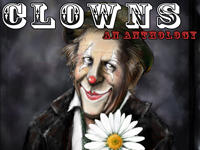
Clowns: The Unlikely Coulrophobia Remix is hot off the presses! So get your hot, pressed clowns today! Or if you prefer your clowns cold-pressed, never fear. A clown is nothing if not adaptable.
22 tales to horrify and delight, by authors Derek Manuel, T. Jane Berry, J.H. Pell, Jeff Wolf, Kristen Roupenian, Carolyn M. Yoachim, Mari Ness, Evan Dicken, Carlie St. George, Line Henriksen, Virginia M. Mohlere, Dayle A. Dermatis, Jason Arias, Joe Nazarre, Karlo Yeager-Rodruigez, Sara K. McNeilly, Chris Kuriata, Cassandra Khaw, Cate Gardner, Charles Payseur, Chillbear Latrigue, and Holly Schofield, with an introduction by Robin Blyn and illustrations by Bryan Prindiville.

 Unlikely Story